3 Conversational Tactics via WhatsApp to Recover Abandoned Carts and Multiply your Sales
Losing sales to abandoned carts? Email isn't enough anymore. Discover 3 conversational WhatsApp strategies to recover customers and multiply your revenue.
It's the figure that keeps any eCommerce owner awake: around 70% of shopping carts are abandoned. A customer shows interest, adds products, gets almost to the end and then suddenly disappears. You've invested in attracting that traffic, but the sale slips away at the last moment. For years, the solution has been the recovery email, but its effectiveness decreases every day in saturated inboxes.
The real opportunity isn't in reminding, but in conversing. And today, conversation happens on WhatsApp.
Why Email is No Longer Enough (and WhatsApp is)
The problem with email is simple: it's a slow and crowded channel. Open rates have dropped and response time is long. By the time the customer sees your email, their purchase intent has already cooled or, worse, they've bought elsewhere.
WhatsApp, on the other hand, offers immediacy and an open rate over 90%. But its real power lies in the ability to transform a monologue (a passive reminder) into a dialogue that resolves doubts and eliminates friction in real-time.
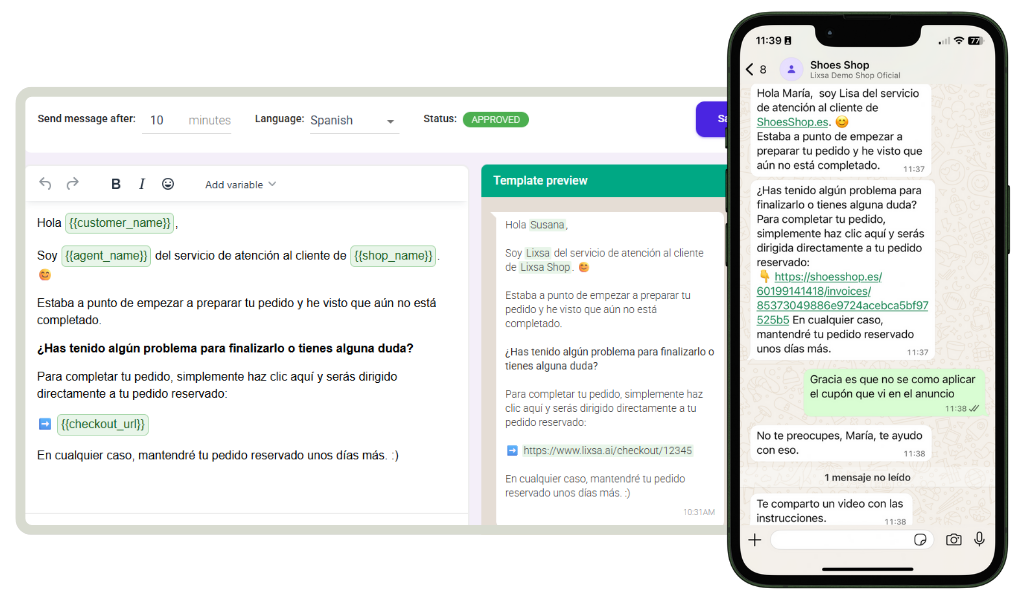
3 Recovery Strategies via WhatsApp that Work
It's not about bombarding with messages, but about being smart and strategic. Here are three conversational angles we've seen generate incredible results.
1. The Proactive Assistant Strategy
The principle: Don't assume the customer forgot. Assume they had a problem or a doubt. This approach changes the perception from a "buy from me" message to a "let me help you" one.
Message example:
"Hi, [Name]! 👋 We saw you were interested in this product. Sometimes questions arise about shipping or payment. Did you have any trouble finishing the purchase? We're here to help!"
2. The Urgency Generator Strategy
The principle: Use scarcity and fear of missing out (FOMO) to incentivize a quick decision. If a product is popular or has low stock, communicating it increases its perceived value.
Message example:
"Wait, [Name]! We see you liked the [Product Name]. It's one of our top sellers and there are only a few units left in stock! 🔥 We don't want you to miss out on it."
3. The Social Validator Strategy
The principle: Reinforce buyer confidence using other customers' opinions. Social proof is one of the most powerful tools to dispel last-minute doubts.
Message example:
"Hi, [Name]! ✨ Great taste! The product you left in your cart is one of our community's favorites. In fact, a customer said: '[Short quote from a 5-star review]'. Want to see for yourself why everyone loves it?"
The Key isn't Just Sending, it's Conversing (and Measuring)
Setting up these strategies seems complex, but the key is intelligent automation. The real magic happens when a customer responds to one of these automated messages. If they ask "how long does shipping take?" or "do you have another size?", they need an immediate response.
This is where a conversational platform becomes essential. A well-trained AI can answer 24/7 to the most frequently asked questions, and escalate to a human agent only when necessary. This way, you close the sale at the moment of maximum intent, without friction.
Conclusion: From a Problem to an Opportunity
Abandoned carts don't have to be a hole in your revenue. With the right approach, they can become one of your best sources of income. Stop sending reminders no one reads and start having conversations that sell. The technology to do this in a scalable and multi-language way already exists, and it's waiting on the channel your customers already use every day.